Visit to Clermont Castle
Visit to Clermont Castle,
an exceptional residence in the Geneva region
 Offered by
Clermont Castle
Clermont en Genevois
Offered by
Clermont Castle
Clermont en Genevois
Description

Visit to Clermont Castle, an exceptional residence in the Geneva region
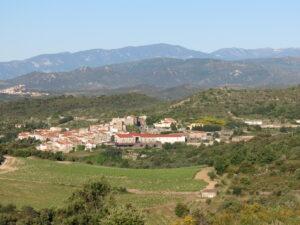
We leave the road from Chambéry to Geneva, once followed by muleteers and soldiers, to climb a molasse ridge that the locals call Le Molard, or Mont Saint-Jean. The ascent is short, but enough to disorient the traveler: as he climbs, the Geneva plain unfolds at his feet, striated by the courses of the Morge and the Usses rivers, and one easily understands why the ancient lords of this place had established their power there.
There was a fortified castle here from the 11th century onwards, which the archives refer to as Clarus mons , Claromont or Clarmonz . The lords of Clermont, vassals of the counts of Geneva , held a garrison there; their line died out towards the end of the 12th century, and the place passed to the counts themselves, who made it the chief town of a castellany, then, in the 14th century, the seat of the bailiwick of Geneva.
Given its location—at the crossroads of the roads to Seyssel and Sallenôves—one can imagine the importance of this fortress for monitoring the surrounding countryside. Recent excavations have unearthed walls over three meters thick and water pipes carved from fir trees, giving a sense of the structure's scale. Today, only foundations remain, scattered beneath the undergrowth; time and human activity have taken their toll.
Because it is another building, lower down on the same ridge, that now holds the visitor's attention, and which deserves a long pause.
A Roman prelate's residence - Visit to Clermont Castle
In 1576, a local boy, who had risen to prominence through the fortunate turns of an ecclesiastical career, obtained permission from Duke Emmanuel Philibert of Savoy to build a residence to his liking at the foot of the ancient castle. This man, Monsignor Gallois de Regard , was no obscure provincial canon: educated in Avignon and then Rome, he was a canon of Saint-Pierre in Geneva and Saint-Pierre in Rome, commendatory abbot of Hautecombe and Entremont, bishop of Bagnorea, chamberlain to Pope Paul IV, and gentleman of the bedchamber to the Duke of Savoy. This means he had seen Rome, its palaces and gardens, before even considering building in his native valley.
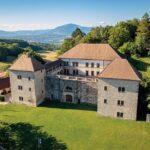
He therefore had part of the old count's castle demolished, its stones used in the new construction, and between 1576 and 1580 erected a pleasure residence that bore no resemblance to a fortress. One would search in vain here for the machicolations and arrow slits of military architecture: the bishop had chosen its location not for defense, but for the view, in keeping with the taste that the Italian Renaissance had recently spread beyond the Alps.
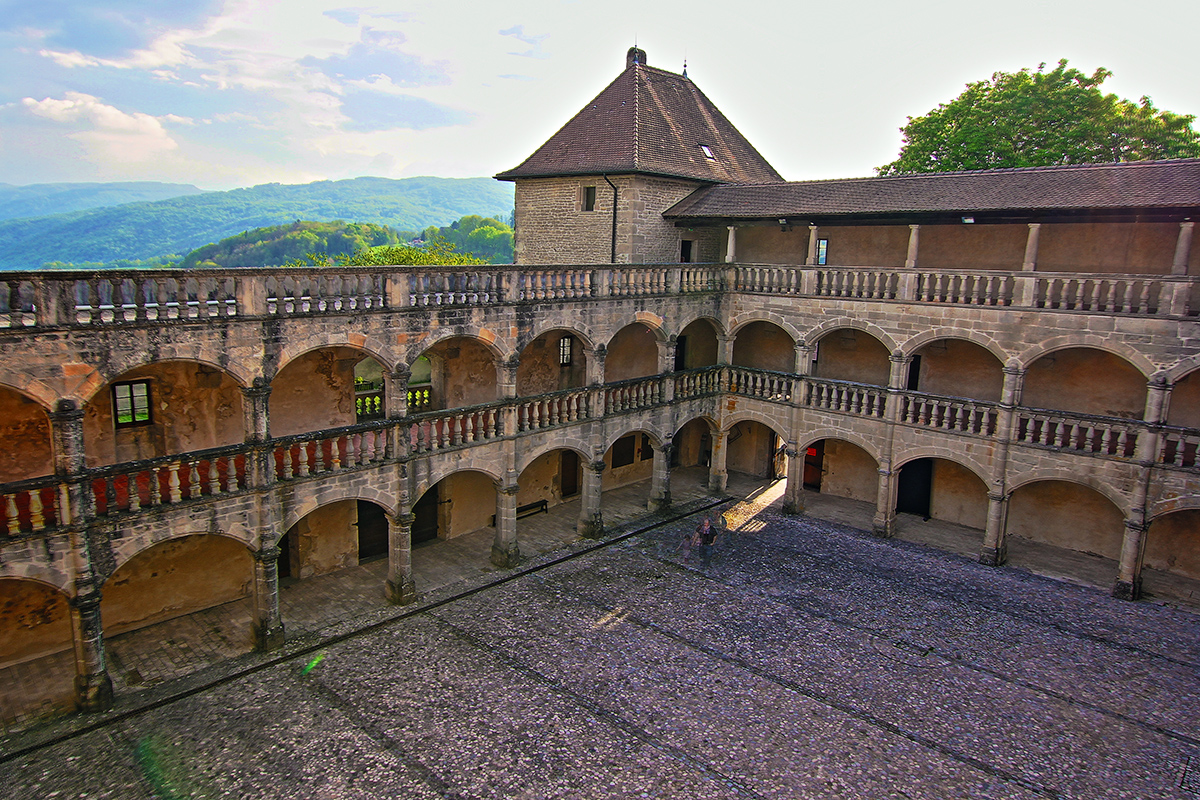
The façade is monumental, ordered with a distinctly Roman regularity; the inner courtyard is bordered by a three-story gallery , whose superimposed arcades recall, in their own way, the courtyards of the palaces that Monseigneur de Regard had frequented in his Italian youth. The work was completed in four years by local craftsmen who, without having traveled themselves, were able to faithfully translate the design of their patron.
The Regard family and their successors - A visit to Clermont Castle
The Regard family long held onto this fine heritage. In 1670, the lands of Clermont were raised to a county for François-Joseph de Regard, steward to Duchess Marie-Jeanne-Baptiste. Another François-Joseph de Regard, in the following century, reorganized the Sardinian army on the Prussian model; a Ferdinand de Regard, finally, took part in the Risorgimento wars, was wounded at Goito in 1848, and died at Novara the following year—a destiny that, as often happens in these old families, blends military brilliance with loyalty to already lost causes.
The Regard family retained ownership of the château until 1860, upon the death of the last of the line, the Countess of Regard de Vars. It then passed to Count Tancrède de Fortis, before being sold in 1921 to farmers, the Cottin family, who were later acquired by the Gay family. Put up for sale in 1963, it was finally purchased by the Haute-Savoie department in 1966 , which saved it from the neglect that too many old Savoyard residences have not been fortunate enough to avoid. Its façades, roofs, and gallery courtyard have been listed as historical monuments since 1950; its interiors, since 1988.
What the visitor sees today
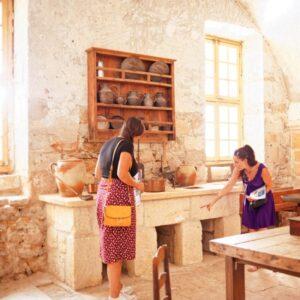
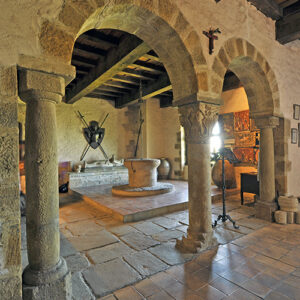
The castle is visited floor by floor, which suits its history of layered construction quite well. On the first floor, the apartments have been furnished to recreate the atmosphere of a Renaissance residence; on the second, an exhibition, using archaeological discoveries and a model, retraces the transition from the vanished medieval castle to the pleasure residence that succeeded it. Visitors with an interest in architecture will linger in the courtyard, beneath the galleries, where the ambition of a man who wanted to bring something of the South from Italy to this Alpine valley is still evident in the stonework.
During the warmer months—April to the end of October— the castle hosts exhibitions, concerts, and performances in its courtyard, which has lost none of its grandeur. Visitors can explore it independently or with a guide; both options have their merits, but I would advise travelers in a hurry to opt for a guided tour, as the history of this place—a count's castle, a prelate's refuge, the residence of Savoyard, then Sardinian, and finally French gentlemen—deserves to be recounted by a voice that knows all its intricacies.
Practical information about visiting Clermont Castle:
Clermont Castle, Montée du Château, 74270 Clermont-en-Genevois (Haute-Savoie). Open from April to November; self-guided or guided tours, activities during the summer season.
Opening and closing times for visits to Clermont Castle
- April, May, October • Weekends and public holidays, • During school holidays (Zone A) from Tuesday to Sunday, 10am to 12:30pm • 1:30pm to 5:30pm
- June, July, August, September: Tuesday to Sunday, 10:30 am to 12:30 pm • 1:30 pm to 6 pm
Prices for visiting Clermont Castle
Complementary information

Customer reviews

No reviews yet.
Log in to leave a review. Login
Supplier information
Clermont Castle
 Clermont en Genevois
 Clermont Castle is one of the rare examples of Renaissance architecture in the former Duchy of Savoy. This pleasure residence was built for Monsieur Gallois Regard between 1576 and 1580. Gallois Regard, a local man, embarked on a long and distinguished ecclesiastical career, acquiring both nobility and wealth, before returning to his native village.
From the 19th century onward, three families succeeded one another at the castle, first nobles, then tenant farmers. The castle gradually fell into disrepair. It became the property of the Department of Haute-Savoie in 1966, followed by restoration and its listing as a historical monument in 1949.
Refurnished in Renaissance style, the castle offers a perfect glimpse into daily life during that period, as well as reflecting the influence of Italian architecture. Since the 2000s, it has been used to share the history of the two castles of Clermont with the public. The first medieval castle, now gone, and the Renaissance one. During the summer, the castle also hosts the "Clermont en scène" Festival, offering a rich program of dance, theatre, music, and circus performances.