Tours & Park and Garden
Château de la Varenne, a park between tradition and evolution The grounds of Château de la Varenne date back to the 1880s , when its current layout is believed to have been designed by one of the ancestors of the present owners. However, its earlier…
 Offered by
Château de la Varenne
Haironville, Bar-le-Duc
Offered by
Château de la Varenne
Haironville, Bar-le-Duc
Description

Château de la Varenne, a park between tradition and evolution
The grounds of Château de la Varenne date back to the 1880s , when its current layout is believed to have been designed by one of the ancestors of the present owners. However, its earlier history remains difficult to trace, particularly concerning the garden that surrounded the château when Pierre Merlin resided there in the 16th century.
A plan from 1793 mentions four flowerbeds on the terrace, probably replaced in the 19th century by a lawn , highlighted by a boxwood border and decorated with cube or ball topiary.
A 19th-century landscaped park
In keeping with the tradition of 19th-century landscaped parks , the estate comprises:
- A central meadow , dotted with groves and bordered by more or less dense woodland .
- Remarkable trees , such as purple beeches, plane trees and tulip trees , chosen for their majesty or rarity.
- Two contrasting perspectives :
- A spectacular overview from the rear terrace of the castle.
- A more fragmented and dynamic view from the perimeter walk, offering varied glimpses of the castle, the Saulx river and the old Haironville bridge (17th century) .
Stone benches punctuate the promenade, each positioned to offer a privileged view of the surrounding landscapes.
An immersion in nature and history
Visitors can explore the park by walking along the river or using the cross paths , allowing for a comprehensive discovery of the grounds. Notable trees are identified by their common and botanical names , and a glossary is provided to help walkers identify them.
Following the 1999 storm , more than 200 trees were replanted in 2002, ensuring the park's sustainability for future generations.
Architectural elements and points of interest
- The gazebo , located at the far left of the terrace.
- A small staircase leading to the terrace, perfect for a break during the walk.
- The Chinese pavilion , a charming half-timbered tower on the riverbank.
- The bench by the Saulx river , inviting contemplation and serenity.
A stroll between nature and heritage
Whether for a bucolic stroll , a botanical discovery or an immersion in the history of gardens , the park of the Château de la Varenne offers an ideal setting to wander and escape in a preserved and charming landscape.
Prices and opening hours
Individual schedules :
Opening period: July 1st to July 12th inclusive, August 5th to August 23rd inclusive, September 2nd to September 10th inclusive. Opening hours: 10:00 AM to 12:00 PM and 3:00 PM to 7:00 PM. Guided tour of the castle interior (listed areas) every day at 4:00 PM. The park can be visited independently with a visitor's guide during opening hours, as well as before or after the guided tour.
Prices :
- Price per adult over 16 years of age:
- €6 for the park visit and the guided tour (which are inseparable).
- €3 for the park visit only.
- Young people under 16: free (visit and park).
Complementary information

Customer reviews

No reviews yet.
Log in to leave a review. Login
Supplier information
Château de la Varenne
 Haironville, Bar-le-Duc
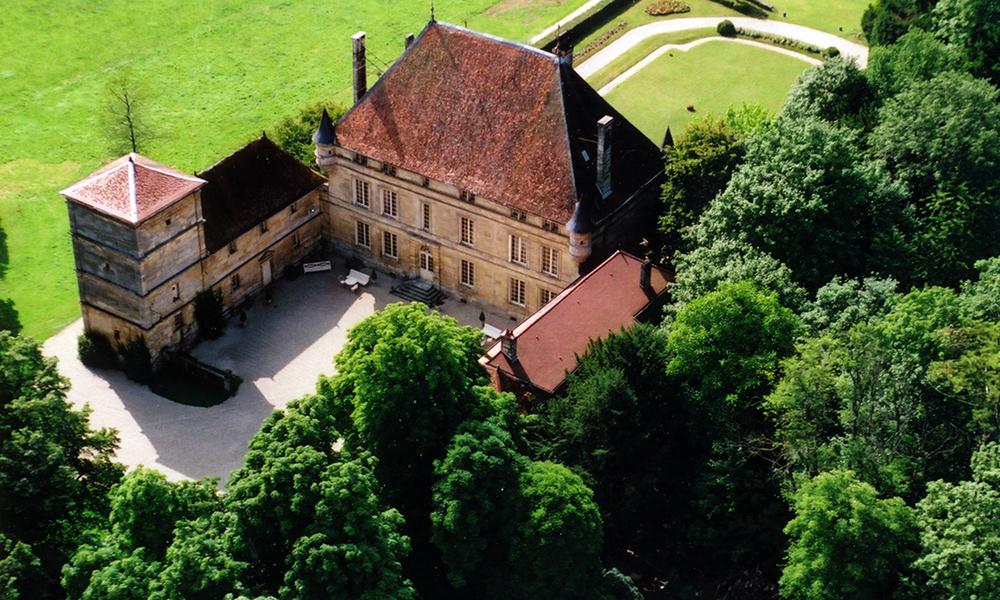
 Pleasure castles during the Renaissance are well represented in the Meuse region, particularly in the magnificent Saulx Valley, a fiefdom of the Dukes of Bar and a favorite retreat of members of the court. The most elegant of these is undoubtedly the Château de la Varenne in Haironville, built in 1506 on the site of a former fortified house by Pierre Merlin, the Duke of Bar's auditor, who was ennobled for his loyal service, especially his trade with the Kingdom of the Two Sicilies.
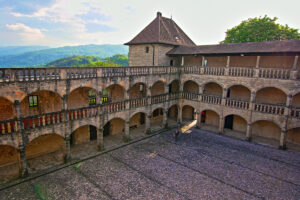
The architecture is understated, devoid of sculpted ornamentation: one is struck by the harmony of its proportions and the purity of its lines. At the four corners of the main building, pepperpot slate roofs crown slender watchtowers. The hipped roof, covered in fish-scale tiles, is as high as the façade. The two wings, built in 1574, define the courtyard, enclosed by a balustrade decorated with stone flower vases, itself dating from the 18th century. The dovecote, a royal privilege, stands next to the house, boasting 3,000 nesting boxes, a testament to the wealth of its former owner.
Inside, in the vestibule, a remarkable and rare Renaissance coffered ceiling of sculpted stone overlooks a monumental staircase with an 18th-century wrought-iron railing.
The park, listed in the inventory of Remarkable Parks and Gardens, bordered by the Saulx River, features magnificent trees and a formal French garden.
The château has belonged to two families: one from its foundation until the early 19th century, and the current owners are descendants of the second family.