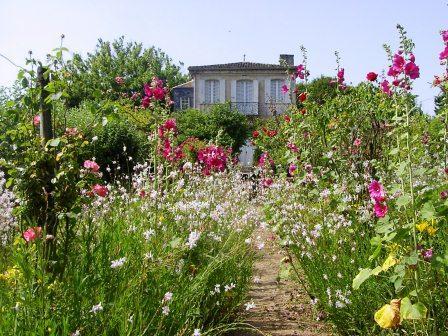
Mongenan Castle, seen from one of the three gardens
Since their creation by Jack Lang, theChâteau de Mongenan has participated
regularly at the Rendez-vous aux jardins by offering free
its visitors receive cuttings of old roses and rare seeds
unavailable in garden centers. It’s a way to reconnect with the
a tradition from the 18th century, a time when seeds were scarce
and expensive because many vegetables had not yet been introduced or
consumed in Europe – tomatoes, potatoes, eggplants – and where the
different varieties of fruit, created by La Quintinie at the request of
Louis XIV, who was very fond of them, made them the subject of a veritable market
black between the different noble houses, all of which possessed a
kitchen garden.
Discovering Mongenan Castle
Antoine de Gascq, who had Mongenan built in 1736 , had created a
famous orchestra, the Académie des Lyriques, whose first sections of
The violin and cello were played by the Sarraut brothers, magistrates.
Like him, they were passionate about musical composition and great friends of Montesquieu.
In 1737, Sarraut de Boynet, the violinist, informed Antoine de Gascq
that he could no longer assume the responsibilities of the Academy. The president
sought to replace him in Bordeaux and Toulouse, and, finding no one
she addressed one of her Parisian friends, the Princess of Savoy
Carignan, mother of the future Madame de Lamballe. The latter pointed out to her a
young citizen of Geneva, violinist, composer, Protestant, in revolt
de ban, who had just arrived in Paris and claimed to be the propagandist
of contested theories of another religious scholar, a certain Linnaeus, who
had just published a book in which he claimed that plants
were sexed and had twenty-four different ways of
to reproduce, which deeply shocked Bishop de Beaumont, Archbishop of
Paris, especially since Linnaeus, in his preface, claimed that
Some plant varieties were the result of relationships between storytelling and nature.
or incest. Rousseau refused to be buried in Bordeaux, but
discussed botany with Gascq, expressing to him that gardens, such
that they were drawn at the time, could not bring happiness to
plants. He suggested creating a completely new garden in his
structure where plants could live in harmony and in
democracy.
Antoine de Gascq accepted. Thus were born the three gardens of Mongenan
which retained from the Baroque design the division into three parts,
ornamental garden, pleasure garden, and utility garden,
arranged around a central axis in successive terraces, which
symbolically represented the owner’s body, his face, his
entrails and its limbs.
This drawing was always kept with the plants that Rousseau had
Recommended and distributed annually: Roses
hollyhocks which were used to correct wines of light, pastel color,
soapwort for laundry, common rhue, indigo, wet pear
mouth, French capon strawberries, chicory, parsnips, Jerusalem artichokes,
gooseberry, Jussieu cannas, catmint for the happiness of
cats, medlar trees, quince trees, olive trees, pomegranate trees etc…
The only thing missing is one of the oldest cedars in France, which once dominated the
house from the garden for enjoyment and that the great storm of
It was shot down in 1999. Two attempts at replacement were made.
unsuccessful, because the soil is exhausted by two and a half centuries of cedar
gourmand.
In contrast, the pleasure garden saw the arrival of [something] under Louis XVI
plants from distant lands: wisteria, from Japan; ginkgo biloba; chimonanthus
praecox, which came from China, Osage orange, which came from America, like the
Virginia persimmon, magnolias, cashew tree,
fringes, sassafras, all carefully acclimatized as were
patiently tending the rose bushes that border the vineyard, much to the displeasure of
those who cultivate it. Mrs. de Parabère, Mrs. de Grossouvre, centenarian of
Lourdes, Cardinal Richelieu, Hazelnut Blush, Lyonnaise candor,
Albéric Barbier, Paul and Scarlett join the cast
climber, Gylislaine de Féligonde and other Dorothy Perkins.
For the Rendez-vous aux jardins event, the visit to the three gardens is
entrusted to SIGM, Savoirs et Images en Graves de Montesquieu. Christiane
Espeut explains the symbolism of gardens, their ability to render
the transparent building, while botanist Nicole Puisné comments
tirelessly studies plants, attaches anecdotes to them, and gives…
cultivation tips.
Naturally, one can, on this occasion, admire the famous herbarium of
Rousseau , inventory of the garden in 137 plates and have it explained
Everything you need to know about the Linnaean classification in honor
of which a pistachio tree, the most sexually prolific tree in the world, almost prevents
he entered the herbarium room, so furious had he been for two
centuries of not having yet found in the vicinity of pistachio orchards
his taste.
Open from 10am to 12pm and from 2pm to 6pm on Saturday and Sunday the 6th and 7th
June 2026, free seeds and cuttings naturally . Guided tour.
of the museum and gardens; Admission €10, free for children up to 12 years old.