
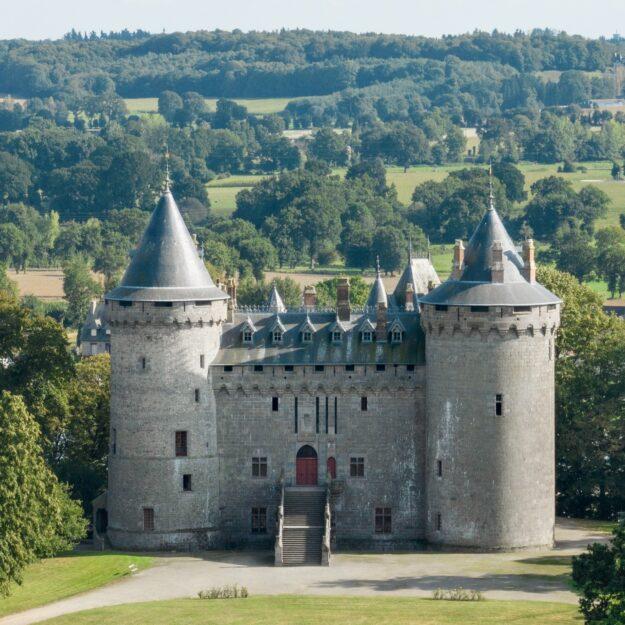
Combourg Castle

No offers are available for this place or chateau.
There are currently no products or offers online. For any inquiries, please feel free to contact us.
Page contactNo images are available for this place or chateau.
Combourg Castle
Exceptional Chateaus & Castles
Our history

Immortalized by the most famous of the romantic writers, François-René de Chateaubriand, this medieval fortress built between the 11th and 15th centuries, admirably preserved and furnished , can be visited on guided tours from April to October.
It houses many of the author's memorabilia, nestled within a vast 25-hectare wooded park. A tea room and a bookshop complete the visit to this place steeped in history and literature.
Combourg Castle , located in Ille-et-Vilaine, Brittany, is one of the region's most iconic landmarks. Built in the 12th century at the request of the Archbishop of Dol, it embodies nearly a thousand years of history, blending medieval and neo-Gothic architecture. This monument, listed as a Historical Monument since 1875, is most famous for having been the residence of François-René de Chateaubriand , one of the greatest French Romantic writers, who spent part of his childhood there and drew his literary inspiration from it.
Medieval Origins and Architecture
The castle was built around 1100 on the orders of Guingéné, Archbishop of Dol-de-Bretagne. Originally, it was a defensive fortress, typical of medieval Breton architecture, with its dry moat , ramparts , and crenellated towers, situated in the heart of the Marches of Brittany. Over the centuries, the castle was enlarged and modified, notably in the 15th century when the Coëtquen family acquired it, adding elements of comfort and prestige, such as the Crusader's Tower and the Guard Room . The castle's almost intact enclosure makes it one of the rare examples in France of such a well-preserved medieval fortified castle . The four towers framing the inner courtyard, linked by curtain walls, present an imposing and mysterious silhouette, typical of Breton fortresses.
The Renaissance and its transformations
In the 16th century , the castle underwent a period of modernization. The owners of the time, such as the Rieux and then the Durfort families , added Renaissance elements, like mullioned windows and ornate dormer windows . However, Combourg remained primarily a fortress, and its austere appearance was preserved. It was during this period that the castle became a more comfortable residence, while still retaining its defensive role. The interiors were furnished with greater refinement, although the medieval austerity remained pervasive.
Chateaubriand and the castle: an unbreakable bond
In the 18th century , the château was purchased by the Chateaubriand family. François-René, born in 1768 in Saint-Malo, spent part of his childhood there between 1777 and 1783. These years profoundly influenced his imagination and his work. In his Memoirs from Beyond the Grave , he evokes with nostalgia and melancholy the dark rooms , the mysterious towers , and the romantic and solitary atmosphere of Combourg.
"The Château de Combourg, with its towers, its keeps, its inner courtyards, its covered walkways, its foundations, its dungeons, its ramparts, its drawbridges, its deep moats, its woods, its ponds, its heaths, offered my imagination an almost infinite world." — François-René de Chateaubriand, Memoirs from Beyond the Grave
Practical Informations
15/12/1997
Total products :
0

