
Who is the current owner of French castles?
France is the country with the most castles in the world: there are more than 45,000 across the entire territory.
France has an exceptional and unique heritage in the world due to its diversity: you will find castles of all styles and periods in France.
What is a castle?
Originally, castles were built to defend a territory and material possessions .
They were then used to store, preserve and protect harvests, currency, manuscripts, tapestries, treasures and many other common values .
Certain common values are assets excluded from any possibility of appropriation or private ownership: no one can appropriate them, nor transfer them.
It is on this legal basis that the Crown's property has been declared inalienable since an Ordinance of King Philip V, subsequently taken up during the Coronation ceremonies (oath that the King takes to France), repeated later by the Edict of Moulins of February 15, 1566, then taken up again in the texts of the French Republic*.
* Article L. 3111-1 of the General Code of Public Property: "The property of the public entities mentioned in Article L.1, which falls under the public domain, is inalienable and imprescriptible."
In France, fortified castles were, from the outset, conceived and designed to be tools for the preservation and defense of the common property of a population.
These castles were not private properties, but constructions authorized by the royal power.
Even though the fortifications, thick walls, barbicans, towers and keep, surrounding walls, ditches, drawbridges, hoardings and parapets with their crenellations and merlons, might suggest otherwise, the castles are eminently open to the population they protect and serve.
In this mission of protecting property and territories, they competed with other civil or religious buildings: abbeys, bastides, towns, cities, citadels, manors, fortified farms, sheltered, preserved, shared, and exchanged common wealth.
With the development of new techniques for the protection, distribution, and dissemination of common wealth came the time for the blossoming of a flower of evil of freedom: private property.
And the castles gradually lost their original purpose, becoming closed off or even turning away from the populations they once served.
The State, regions, departments, towns and villages, associations and some families are giving themselves the means to preserve French castles.
Here are some examples of successful openings to the public of "private" castles: Chenonceau, Cheverny, Amboise, Vaux-le-Vicomte, Breteuil.
Chateaux-France offers you the opportunity to discover these places, "private properties" or "public properties", they are all common property.
How do you feel as a princess?
"How do you feel to be a princess?" was one of the very first messages received and forwarded by Chateaux-France.
In 1995, a few days after the site's launch, a young internet user from California asked this ingenuous question to the Princess of M.
The precious message was delivered to its recipient, who had neither an internet connection, nor a fax machine, and even less email.
It was therefore by mail that the message reached the Princess of M.
The latter then replied to her little Internet Princess, via Chateaux-France.
An exceptional relationship was born between a French grandmother and a young Californian princess!
The direct connection between "owners" and their public has remained in the genes of Chateaux-France: promoting "one to one" contact with sharp tools in compliance with the GDPR.
What are the castles of the kings in France?
We have already seen that the ownership of castles and palaces is a matter of public order and is not up for debate: they do not belong to a person or even to a family.
Castles are the common property of a people: inalienable, inalienable, intransigible. And are simply marked by the residence, the sojourn, the passage of a person particularly enlightened by history.
But then, what is a king's castle?
And then, what is a king's castle in France?
Royal castles could therefore be their place of birth (Pau, Saint-Germain en Laye, Le Louvre, Versailles…) of residence, of assemblies or councils (they regularly or occasionally hold their Seat , in Cabinet , or Bed , in Chamber ), of passage, of exile, of confinement and of disappearance…
In France, the kings first bore the title of King of the Franks, then that of King of France, and finally, the title of King of the French.
The evolution of these titles reflects the importance of the territory over which our kings lived and reigned. And this territory was constantly evolving. If we follow the rule of the royal jurists, who largely contributed to the construction of the concept of France, we will consider the original territory conquered by the Frankish invaders, and that of West Francia, which followed the Carolingian partition.
The Palace of Attigny, castle of the kings of France
Among the very first places of residence and seat of the kings, the Royal Palace of Attigny, acquired by Clovis II in 651 and which from 749 became the residence of the Mayor of the Palace, Pepin the Short, who became King of the Franks in 751, and his residence one of the places of passage of the kings.
Besides Pepin the Short, several Carolingian kings and emperors stayed there: Carloman I, Charlemagne, Louis the Pious, Charles the Bald, Louis III, Carloman II, Charles the Fat, Charles the Simple, and Raoul. Charles the Bald made the most frequent visits: 23. Charlemagne stayed there 4 times, including two Christmas celebrations.
This palace is located near the Roman road from Reims to Trier and held practical importance for the Frankish kings: it served as a staging post between the east and west of the Frankish kingdom, and later between the kingdoms of West Francia and Lotharingia. It also provided a meeting place for leaders from these different regions: numerous assemblies, colloquies, and councils were held here.
The palace of Attigny ceased to be frequented by the kings of the Franks after 931 and nothing remains of it today.
The current building, known as "Charlemagne's Palace," built on its ruins, dates from the Renaissance. Henry IV probably stayed there during his two visits to Attigny, in October 1591 and October 1592.
The Château de Pontoise, castle of the kings of France
The castle overlooked the bridge over the Oise on the road from Paris to Rouen.
The name "Pontoise" reveals the importance that the Franks then gave to bridges in their confrontation with the Vikings.
These same Vikings, after invading Normandy and settling there, carried out raids into Frankish territory. They systematically moved their troops in boats and vessels called "karv", "snekkja" or "dreki", going up the rivers.
Their strategy was essentially based on rapid movements for "commercial" purposes: pillaging a territory, then demanding tribute to leave it.
In 885, the Norman Vikings, aboard 700 boats, entered the Oise, besieged and captured the town, then withdrew.
In response, the inhabitants settled on Mont Bélien, which was easy to defend. The town of Pontoise was permanently established there. A castle was built there by the Counts of Vexin.
Later, the Oise River was crossed via a new fortified bridge built around 1070, which blocked the passage of unwanted fleets. The town was surrounded by a wall, the bridge over the Oise, rebuilt in stone, was fortified, and the powerful royal castle, overlooking the town and the Oise, was itself rebuilt between 1103 and 1122.
Louis VI "the Fat" (1081-1137) victoriously defended the French Vexin against the multiple assaults of the Duke of Normandy, King of England.
Louis VI was a reforming king who encouraged communal movements, professional, social, and religious associations. As early as 1110, he granted the inhabitants of Pontoise tax advantages and the right to self-government under the direction of a mayor.
From the time of Louis VI, the Château de Pontoise became one of the favorite residences of the Capetians, notably Philip Augustus and Saint Louis.
Louis XIV took refuge at the Château de Pontoise during the Fronde, and brought the Parliament there in 1652.
The castle was subsequently abandoned and then dismantled in the 17th century. Only remains stand above the Oise river.
The castles of Poissy and the kings of France
Poissy was a royal residence as early as the 5th century. In 862, 864, and 868, Charles the Bald held assemblies of dignitaries there. From 996 to 1031, Robert the Pious established it as a royal residence and had the Church of Notre-Dame built. His second wife, Bertha of Burgundy, founded a women's monastery.
Under the Capetians, there were two castles in Poissy. The first, the Old Castle, next to the collegiate church, dates back to an old Merovingian hunting lodge. The second is the New Castle, likely built by Constance of Arles, third wife of King Robert II the Pious, on the site of the abbey enclosure and adjoining the Old Castle, probably on the site of the abbey church's high altar.
In 1188, Philip Augustus endowed the city with communal institutions, in exchange for the burghers taking charge of the city's fortification works and providing military service.
In 1200, he entrusted the castle as an appanage to his son Louis VIII the Lion on the occasion of his marriage to Blanche of Castile.
In 1221, Philip Augustus granted the town a charter of commune, confirming its right to self-government. Poissy is thus one of the oldest communes in France.
During his reign, the town was surrounded by ramparts which remained until the 19th century and whose remains are still visible. It was also around 1200 that the town of Poissy built the stone bridge which stood until 1944, replacing a wooden bridge.
Louis IX was born in 1214 at the castle of Poissy. He was baptized in the parish church of Notre-Dame; subsequently, he signed his private letters "Louis de Poissy" or "Louis, seigneur de Poissy" in memory of his baptism.
In 1245, Philip III, the Bold , son of Louis IX and Margaret of Provence, was born in Poissy and reigned from 1270 to 1285.
In 1297, following the canonization of Louis IX, King Philip the Fair decided to found the Dominican Abbey of Poissy in honor of Saint Louis, his grandfather. Construction of the priory began in 1303 on the site of the new castle, which was demolished.
During the Hundred Years' War, on August 16, 1346, the King of England, Edward III, sacked and burned the city after landing in Normandy and devastating the Seine Valley, the Vexin, the Beauvaisis, crossing the Somme and defeating Philip VI of Valois at Crécy before taking Calais.
In 1369, King Charles V the Wise had what remained of the castle of Poissy destroyed, which had been burned down on August 16, 1346 by the Black Prince, son of the King of England.
The Palais de la Cité and the Kings of France
At the forefront of the castles of the Frankish kings, in Paris, stood the Palais de la Cité , on the area occupied today by "36 quai des orfèvres", the Place Dauphine, the Conciergerie, the Sainte Chapelle and the Court of Appeal of Paris.
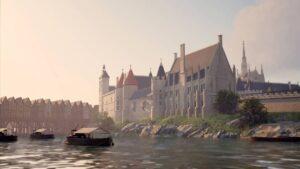
01 – 3D representation of the Palais de la Cité and its surroundings in Paris, towards the end of the 16th century (Films à Cinq).
It is the oldest of the royal residences in Paris.
Indeed, in Roman times, Paris (Lutetia) was an important city from an administrative and military point of view. It replaced an ancient Celtic city, established on the heights of present-day Nanterre.
A defensive wall was erected on the island of the Cité, sheltering the residence, pallatium, of the Roman emperors Julian II (331-363) and Valentinian I (321-375), then of the Merovingian kings — from Clovis I (466-511), then Dagobert I (605-639).
During the Carolingian era, kings did not reside in Paris. It was during the siege of the city (885-887) that Paris found a leading role due to its strategic position: in the center of West Francia, the city blocked access against Viking raids targeting rich Burgundy.
Eudes, Count of Paris, future King of France and founder of the Robertian dynasty, would set about defending Paris and then consolidating the ramparts damaged by 3 years of war, sieges and pillaging carried out against the city (between November 24, 885 and January 887).
Eudes lived in the besieged City Palace between the end of November 885 and the end of May 886. He returned there in September 886, accompanied by Emperor Charles the Fat, and forced the Viking troops to leave the city which they had then partially occupied.
Hugh Capet (939-996) and his son Robert II the Pious (972-1031) then undertook to make it a royal residence.
Philip II Augustus (1165-1223) expanded and embellished the Palace, so that it would become the most important palace in the Christian West.
He installed the royal archives there (reconstituted and deposited in the Palace, which became the center of the royal administration).
At the same time, he erected the Louvre fortress, a bastion of the new fortification of Paris.
Successive kings continued to expand the Palace of the City:
Louis IX (Saint Louis, 1214-1270) had the Sainte-Chapelle built, which housed the relics of the Passion of Christ, as well as the building of the Treasury of Charters, attached to the Sainte-Chapelle, which then received the royal archives.
Louis IX lived mainly in three castles:
– First, the Château de Pontoise, where he was born,
– Next, the Palais de la Cité in Paris, which he enlarged and considerably enriched,
– Finally, the Château de Vincennes.
Philip IV the Fair (1268-1314) enlarged the Palace to house the administrative institutions of the kingdom:
– the Guards' Room
– the Hall of the Men-at-Arms in the palace,
– The "Great Hall", to the north, replaces and doubles the original area of the King's Hall. Its dimensions and decoration make it the most remarkable royal hall in medieval Europe.
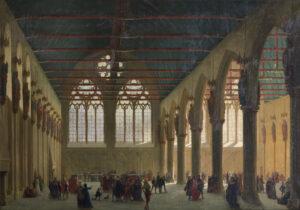
02 – Representation of the Grand'Salle by Sébastien Charles Giraud, Oil on canvas – 1878 (Collection of the Palais de Justice in Paris)
He erected buildings designed for the new institutions:
– The Chamber of Accounts, to the west of the Sainte-Chapelle.
– The "Grand' Chambre", built from 1302 to 1305, above the Guards' room preserved within the Conciergerie, became from 1314 the seat of the Parliament of Paris, the highest jurisdiction of the kingdom responsible for registering royal ordinances.
– The Silver Tower and Caesar Tower along the clock quay housed the royal administration.
Finally, the square kitchen pavilion was built under John II the Good (1319-1364).
The Palais de la Cité was then the most beautiful, the largest and the most sumptuous palace in Europe.
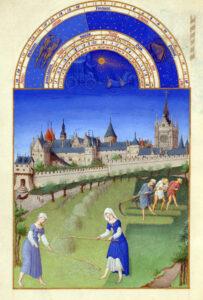
03 – Illumination from the Très Riches heures du Duc de Berry – Limbourg brothers (Herman, Paul and Jean) 1412-1416. Coll. Château de Chantilly.
Charles V (1338-1380), who preferred the Louvre and Vincennes, put an end to four centuries of royal residence in the Palace.
Having become an occasional residence, entrusted to a concierge, the Palais de la Cité will henceforth be called the "Conciergerie" and part of the buildings is transformed into a prison.
The Palace hosted the major trials of the revolutionary tribunal between 1793 and 1795, before being transformed into a courthouse in the 19th century.
The Louvre Palace and the Kings of France
The Louvre, the western fortress of the new walls of Paris, was initially given a military mission: the King who had ordered its construction wanted to secure the city.
The Louvre, a residential palace:
It becomes a royal residence with
The Louvre, the seat of government:
On October 22, 1652, Louis XIV held a Lit de Justice at the Louvre Palace, by which the King forbade the Parliaments from interfering in state or financial affairs without having been invited to do so.
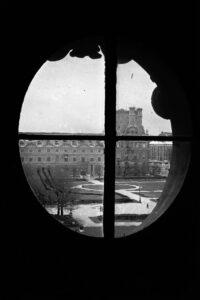
One can imagine that, from the window of his office, Louvois, minister to Louis XIV, enjoyed watching over the court of the Palace.
The Louvre, a palace of culture:
Charles V established the Royal Library in the Falconry Tower, a space organized for the dissemination of knowledge and open to the public. The Louvre's cultural vocation was born.
King Louis XIV decided to house the collections of sculptures and paintings there and to welcome artists in residence, thus confirming the cultural vocation of the palace.

The Louvre and its Grand Design:
Henry IV, with his Grand Design , gave the Louvre a grand dimension by planning to unite the Tuileries Palace (built on the orders of Catherine de Medici) and the Louvre castle.
The Grand Design project envisioned by Henry IV would take years to come to fruition, without ever being completed: the Royal Palace of the Tuileries was set on fire by the Communards Dardelle, Bergeret, Bénot, Boudin and Madeuf in 1871.
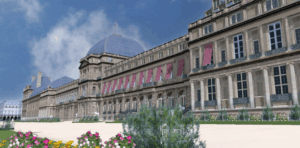
The Château de Vincennes and the Kings of France
In 1162, Louis VII enclosed part of the woods with walls, and later had a hunting lodge built. In the 13th century, Philip Augustus and Louis IX (Saint Louis) had a manor house constructed.
Louis IX regularly went there with his wife, Marguerite of Provence, and their children and held his Council meetings there, managing the administrative and legal affairs of the Kingdom.
The Château de Villers-Cotterêts and the Kings of France
In 632, Dagobert I hunted in the Retz forest. The kings who succeeded him had a residence built there.
A new chapter in the château's history begins with François d'Angoulême, the future François I, who receives the Duchy of Valois from his cousin, Louis XII, at the heart of which lies Villers-Cotterêts. In 1528, François, now King of France, launches a series of building projects, from the Louvre, which he expands, to the château at Fontainebleau, which he constructs.
And, to indulge in hunting, he erected a royal palace in the middle of the Retz forest, the largest in France at the time.
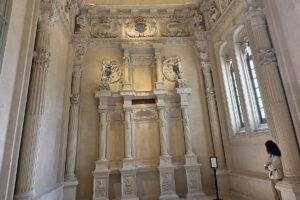
In 1539, Francis I signed an Ordinance there, still in force, which harmonized the French language in administrative and legal acts.
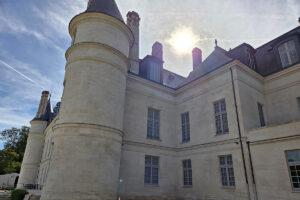
While the castle served as the center of the country's economic and political activity during the kings' visits, it was also the setting for impressive festivities. "Mon Plaisir" (My Pleasure) is the nickname that Francis I is said to have given to the Château de Villers-Cotterêts.
which the popular saying has taken up: to have fun like in Villers-Cotterêts .
Under Napoleon I, the castle became a workhouse for beggars, forcibly housing the destitute, both men and women, then between 1889 and 2014, it was transformed into a retirement home… Then left to decay.
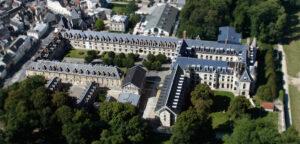 08 – Aerial view of Villers-Cotterêts Castle
Under the leadership of President Emmanuel Macron, the restored château has been given a new mission, in keeping with its origins, to become the International City of the French Language . It has thus become once again a "royal château," open to all.
Madrid Castle and the Kings of France
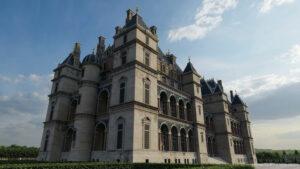
09 – 3D reconstruction of the Boulogne castle, also known as Madrid castle (Hervé Grégoire)
Construction of Madrid Castle began in 1528 on the orders of France's Francis I, who had returned from captivity.
Destined for demolition on the orders of Louis XVI, the Château de Boulogne, also known as the Château de Madrid, disappeared definitively at the beginning of the 20th century.
Located on the edge of the Bois-de-Boulogne, its gardens, 700 meters long, run towards the North, alongside the wood.
A masterpiece of the French Renaissance, around which the architects Philibert Delorme (1548), Le Primatice (1559), then della Robbia would strive to create an innovative palace decorated with enameled and colored tiles, true French-style azuleros.
Originally intended by Francis I to be his castle of Boulogne, it was quickly called the castle of Madrid at court (following the battle of Pavia, the King was held captive in Madrid by Charles V).
The château subsequently became one of the preferred Parisian residences of Charles IX and Catherine de Medici, particularly during the St. Bartholomew's Day Massacre (summer 1572). Abandoned by Henry III, it was inhabited by Marguerite de Valois in August 1605. Louis XIII visited it in 1610.
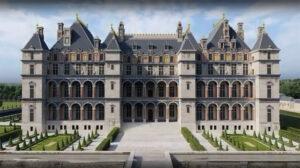
10 – 3D reconstruction of the Château de Boulogne, also known as the Château de Madrid (Hervé Grégoire)
The decline of this royal residence began with Louis XIV, who established the first silk stocking factory in France there.
By letters patent of 1656, the King promised a monopoly on this activity, established in the castle which had become a stocking factory.
Alas!
While the wealthy like to wear silk stockings, they do not like wool stockings, and public finances struggle to find them.
The affair fizzled out, and the promise of a monopoly was stifled by competition from the silk manufacturers of Lyon, Nîmes (who would reorient their production towards cotton fabrics dyed blue: the blue of Nîmes, which passed into English under the original expression blue de Nîmes , then commonly: Blue Jeans* ), Orange, Montauban and Chambéry.
In 1787, Louis XVI ordered it put up for sale. Acquired by demolition contractors who paid for it in assignats, dilapidated and ruined, it nevertheless survived for another 200 years, divided into apartments, then used as a clinic, briefly converted into a stud farm, and finally transformed into a restaurant under Napoleon III. What remained of the Château de Madrid was finally demolished in 1909.
* Michel Pastoureau: Blue, the History of a Color, Seuil Publishing
The Château de Fontainebleau and the kings and emperors of France
The Château de Fontainebleau, a royal and imperial palace, successively hosted 36 French sovereigns.
It is thus the only palace visited by all sovereigns, kings and emperors, for more than 8 centuries.
With 1500 rooms, Fontainebleau is one of the largest castles in France, and the most furnished in Europe.
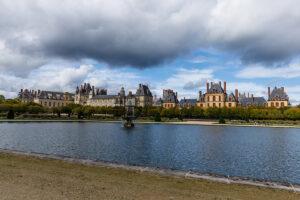
In the Middle Ages, then in the Renaissance, from Francis I and Henry II in the 16th century to Emperor Napoleon III in the 19th century, passing through Henry IV, Louis XIII, Louis XIV, Louis XV and Louis XVI, or even Louis-Philippe I and especially Napoleon I, all its residents left traces of their passage at the castle, gradually shaping the originality of Fontainebleau: an eclectic and evolving architecture without stylistic unity.
Fontainebleau is a reflection of the history of the monarchs who lived there and, more broadly, of the history of France.
The first time a French king visited Fontainebleau was Louis VII the Younger in 1137. Fontainebleau was then a medieval castle, its layout following the outline of the present-day Oval Courtyard. The square keep, which for a long time served as the kings' residence, and the Chapel of Saint-Saturnin, rebuilt by Francis I, still remain.
It was already being called the Palace of Fontainebleau at that time.
The Royal and Imperial Palace of Fontainebleau offers masterpieces to see today:
– from the Renaissance, commissioned by Francis I,
– the great works of Henry IV,
– the refined interiors of Marie Antoinette,
– Napoleon I's state apartment,
– the splendors of Napoleon III. 
Located in a 130-hectare park, the castle unfolds its architecture around four main courtyards, at the heart of three historic gardens, including the Grand Parterre, the largest in Europe (11 hectares), which is the work of André Le Nôtre.
The Château de Blois and the Kings of France
For more than a thousand years, the royal castle of Blois has successively hosted the Counts of Blois, the Dukes of Orléans and then the Kings of France, who have left their mark and linked the castle to the history of France and Europe.
In the 9th century, a fortress was built on the promontory overlooking the city of Blois and the Loire, and a count's palace was incorporated into it.
A century later, the Counts of Blois erected a tower and new buildings, which were regularly enlarged. Of these medieval constructions, the royal castle of Blois retains buildings from the 13th century: the great hall, part of the rampart and three towers which are integrated into the François I wing, and finally the Foix tower.
From 1498 onwards, Louis XII transformed the fortress into an urban palace. A new royal residence was built. This building features, on the courtyard side, an open gallery alternating pillars and columns leading to two stair towers that provide access to the upper floors. On the square side, the long brick façade houses the equestrian statue of the king.
In 1515, immediately upon his accession to the throne, Francis I undertook the first major project of his reign, constructing a building in Blois inspired by the Italian Renaissance. On the courtyard side, the majestic façade features the central staircase known as the Francis I staircase, whose massive buttresses contrast with the delicate windows. The exterior façade is composed of loggias that, at the time, allowed for views of the gardens.
Gaston d'Orléans, brother of King Louis XIII, who was then without an heir, decided in 1634 to build a completely new castle in Blois. He called upon the architect François Mansart, who erected a main building at the rear of the courtyard, the beginnings of a vast and ambitious reconstruction project then aimed at the entire Royal Castle of Blois.
But construction was halted in 1638. Because the birth of the King's son then removed Gaston from the throne and the residence remained unfinished.
The Château d'Amboise and the Kings of France
The prehistoric site of Amboise has been inhabited for several millennia. During the Roman era, a walled town was established.
The city suffered from Viking raids and the Frankish kings entrusted its defense to the lords of Amboise.
The royal castle of Amboise successively housed the lords of Amboise, then the kings of France.
The lords of Amboise are credited with successfully fortifying the site and the town between the 9th and 10th centuries. Amboise was then considered the best-protected place in Western France.
In 1431, Louis d'Amboise participated in a plot against Georges I de La Trémoille, a favorite of Charles VII. Unmasked, he was condemned to death and his castle was confiscated, becoming part of the Royal Domain.
In 1433, the son of Charles VII, the Dauphin Louis (future Louis XI), was at the castle of Loches for his education; he could find refuge in Amboise in case of threat from the allies of the Burgundians, during the civil war between Armagnacs and Burgundians.
On October 7, 1461, Louis XI came to greet his mother, Marie d'Anjou, after his coronation in Reims.
Louis XI then had his own son (the future Charles VIII) educated there. Having been born at the castle in 1470, the Dauphin Charles appreciated Amboise and made it his preferred residence.
Charles VIII had it built there between 1492 and 1498:
– the Saint-Hubert chapel,
– the wing, now called the Charles VIII wing, in the flamboyant Gothic style, which includes the King's and Queen's apartments,
– the two cavalier towers (Minimes tower and Heurtault tower),
– a park is laid out on the terrace; later, a bust of Leonardo da Vinci and a Muslim memorial (for the companions of Abd El Kader who died in Amboise during his captivity) are installed there.
Louis XII (1498-1515), his cousin and successor, had a second wing built there, perpendicular to the Charles VIII wing, in the Renaissance style. He ceded the estate to Louise of Savoy, who raised her two children there, Marguerite and François (the future François I).
Francis I (1515-1547) and his court were still residing at the royal castle in 1518. However, his stays there gradually became less frequent. Although construction continued, with the completion of the Heurtault Tower and the remodeling of the Louis XII wing, Francis I preferred Villers-Cotterêts, Chambord, Blois, or Fontainebleau.
He nevertheless invited Leonardo da Vinci to stay in Amboise at Clos Lucé, near the château. Leonardo da Vinci died in 1519 in Amboise and was buried in the collegiate church of Saint-Florentin, demolished in 1810 by the 3rd Consul of France, Roger Ducos.
Henry II (1547-1559) further enlarged the castle by ordering the construction of new buildings on the eastern part.
Under Louis XIII the castle was transformed into a luxury prison for the great figures of the State: César de Bourbon, Duke of Vendôme, and his brother Alexandre de Vendôme, were interned there for their participation in the Chalais Conspiracy against Cardinal Richelieu in 1626.
The castle then passed to Gaston of France, Duke of Orléans, brother of Louis XIII.
Louis XIV (1643-1715) confiscated it and restored its role as a prison: Amboise thus welcomed Nicolas Fouquet and Antonin Nompar de Caumont, Duke of Lauzun.
The Duke of Choiseul acquired it in the 18th century, then abandoned it around 1760 in favor of Chanteloup.
After his death, the estates of Amboise and Chanteloup were bought by Louis-Jean-Marie de Bourbon (1725-1793), Duke of Penthièvre. Upon his death, it became national property.
A large part of the castle was demolished during the First Empire, when Napoleon I offered the castle, already in poor condition, to the ex-consul Roger Ducos who strove to destroy two-thirds of it (including the Saint-Florentin collegiate church and the queens' residence), between 1806 and 1810.
The Château d'Amboise will house one last prisoner: Emir Abd El Kader, who resides there with his entourage and companions.
In 1873, the castle passed to the Orléans family. Henri d'Orléans, Duke of Aumale, transformed it into a care home for the elderly.
Today, the Saint-Louis Foundation, established by the Count of Paris in 1974, is in charge of the Château d'Amboise.
The Château de Chambord and the Kings of France
The Château de Chambord is the most famous of the castles and palaces built during the Renaissance.
It is fully part of the Loire Valley castles.
The name Chambord comes from the Celtic-Gallic language, which designates the place by the association of the two words: cambo-rito – means passage on a meander; that is to say a ford in the curve of a river.
This ford created a marsh on which a bridge was built, mentioned as early as 1307 in the will of Count Hugh II of Blois.
Rising straight from the marshy lands of Sologne, the Château de Chambord bears witness to the history of a palace conceived as a symbol.
A fortified castle existed in the 10th century. Located 6.7 km northwest of Montfrault, it was intended for the Counts of Blois, who resided there until the 14th century.
In 1397, the Château de Chambord passed to the House of Châtillon, then to the Dukes of Orléans, along with all the possessions of the Counts of Blois. At that time, the fortified castle was used as a pleasure residence and hunting lodge.
It was then attached to the French crown when Louis d'Orléans became Louis XII of France in 1498.
Chambord is the embodiment of a royal project
From his campaigns in Italy, Francis I returned crowned with the glory found on the battlefield, but also amazed by the refinement of the Italians of the Renaissance.
A great hunting enthusiast, Francis I wanted to build a palace in the game-rich Sologne region, a palace whose magnificence would rival the finest constructions in Italy. Thus began the story of the Palace of Chambord in 1519. With its 400 rooms and hundreds of fireplaces, Chambord would go down in history as the castle envisioned by Francis I, even though he resided there for only 72 days. Chambord is the story of a carefully staged display of royalty.
His project is to create a new city in Romorantin, based on the plans of Leonardo da Vinci, and, in Chambord, a large building in the Neoplatonic style.
The Palace, according to Leonardo's initial plans, represents a wheel dominating wild waters, tamed, diverted and channeled by the King.
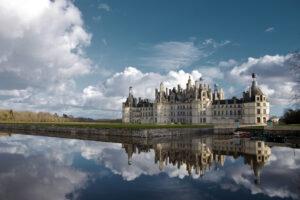
It is thus intended to be an ideal palace.
Accompanied by a pleasure garden, set in the middle of a hunting park, it is also the largest of the Loire castles.
History of the Château de Chambord: a difficult construction
The Château de Chambord is built on a marshy area.
One of the strokes of genius of its designer was to build a massive edifice, in hewn stone, on soft and unstable ground, by placing the Château de Chambord on stilts.
The construction methods will be a landmark in the history of architecture and engineering: the 220,000 tons of tufa stone rest on wooden piles, driven into the ground.
The work begins with the destruction of the old fortified castle, the village church and the construction of the foundations of the square keep.
Interrupted between 1525 and 1526 (defeat at Pavia and imprisonment of the King in Madrid by Charles V), construction resumed from 1526. The King modified his project by adding two lateral wings to the original keep, one of which was to house his residence.
Considerably modified during the 28 years of its construction, from 1519 to 1547, the Château de Chambord was not entirely completed when François I received his rival, Emperor Charles V, there on December 18, 1539.
The castle is organized around its magical double-helix staircase, designed to dazzle visitors and testify to the power and genius of French royalty.
A jewel of French history protected by the authorities
The history of the Château de Chambord has protected it from the great upheavals of its time.
It presents the idealized appearance of a medieval fortress, which symbolically establishes the martial authority of King Francis I.
However, he did not experience the medieval wars.
Attached to the French crown, the Château de Chambord was inhabited by Charles IX, then abandoned for a century, it successively welcomed Louis XIII, Gaston d'Orléans, Louis XIV.
Louis XV established Stanislas Leszczyński, King of Poland in exile, there, then gifted it to Marshal de Saxe in 1745.
What followed, until the French Revolution, was a series of private occupations of the castle: August von Friesen, nephew of Marshal de Saxe, until 1755, then the Marquis de Saumery until 1779, and finally the Marquis de Polignac, driven out by the Revolution in 1790.
The inhabitants of the neighboring villages then ransacked the estate and looted the castle.
Napoleon I intended it to house the boarding school for girls of the Legion of Honour, but his project did not come to fruition.
Purchased through national subscription in 1821, the Chambord estate was given to the great-nephew of Louis XVIII. It was passed down by inheritance to the Count of Chambord, Henri V, who lived there and restored it.
Purchased in 1930 by France from a descendant of the Count of Chambord, the Chambord National Estate is placed under the special status of Presidential Domain. The public can admire the castle and the gardens there.
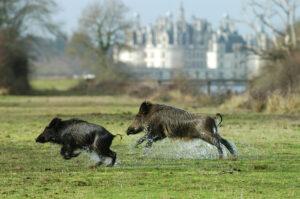
The walled enclosure surrounding the entire estate, as well as the forest park, allows for the observation of wildlife, which is very present in the 5500-hectare park, now known as the Presidential Hunts .
Chenonceau Castle , the Queens of France and their Ladies
Katherine, Diane, Catherine, two Louises, Marguerite, Simone…
First, there was the builder of Chenonceau: Katherine Briçonnet , whose husband, Thomas Bohier, was the finance minister to Francis I. While he was on the battlefield, she became the architect of the château, overseeing its design and construction. She made all the architectural decisions. Their initials, TBK (Thomas Bohier and Katherine), can be found in the château, along with the phrase: "If he comes at the right time, I will remember."
Next came Diane de Poitiers, who had terraces and gardens built, as well as a bridge, on which Catherine de Medici imagined the famous galleries.
Louise of Lorraine sought refuge there after the death of her husband, King Henry III. She lived there for the eleven years of her mourning, immersing herself in contemplation and prayer. Never having recovered from the sudden loss of her beloved, she adopted a white wardrobe, earning her the nickname "White Queen" or "White Lady of Chenonceau." Indeed, unlike today, the color of royal mourning was white, a color Queen Louise never abandoned until her own death. At Chenonceau, her room remains famous for being adorned with funerary motifs, symbols of mourning, and dark fabrics.
Next came Louise Dupin , who had a small theater built at the southern end of the gallery on the first floor of the Château de Chenonceau. She also practiced patronage. A feminist, she advocated for women's education, access to public employment, and careers previously reserved exclusively for men. She authored an unfinished work, * The Defense of Women and Equality Between the Sexes* , between 1745 and 1750.
She died and was buried on the Chenonceau estate.
Marguerite Pelouze , a major figure in French political and artistic life at the end of the 19th century. In 1888, she went bankrupt and had to sell the Château de Chenonceau, which was bought by Crédit Foncier, then on April 5, 1913 by the industrialist Henri Menier.
Simonne Menier , herself a nurse and wife of Georges Meunier, decided to dedicate two galleries of the castle to the wounded of the Great War.
The wounded soldiers receive care, food, and modern medical equipment, all donated by the home. While Simonne personally manages the medical team, her husband, Georges, handles the administration.
In total, 2,254 Poilus thus led a life of luxury at Chenonceau during the Great War.
The Luxembourg Palace and the Queen of France
The Luxembourg Palace is built on the site of a 16th-century mansion that belonged at the time to François de Piney, Duke of Luxembourg.
In 1612, Marie de Medici, the regent of France, widow of Henry IV and mother of Louis XIII, having regained favor with her son and Cardinal Richelieu, purchased the hotel and estate known as "Luxembourg". In 1615, she commissioned the construction of a palace, after having the houses and part of the Petit Luxembourg demolished.
From 1616 onwards, the queen mother took up residence on the first floor of the West wing, in the part of the Medici palace reserved for her; the East part was intended for her son, King Louis XIII.
Marie de Medici was forced to leave the Palace in 1631, exiled on the orders of her son following the "Day of the Dupes".
She bequeathed the estate to her second son, Gaston, Duke of Orléans, brother of Louis XIII.
The building was then known as the "Orléans Palace". It passed by inheritance to his widow, Marguerite of Lorraine, then to his eldest daughter, the Duchess of Montpensier, who sold it to her younger sister, the Duchess of Guise. The latter gifted it to the king, her cousin, in 1694.
In 1715, the Luxembourg Palace, or Orléans Palace, reverted to the regent Philippe d'Orléans, who gave it to his eldest daughter, the Duchess of Berry, who led a life of parties and pleasures there and died in July 1719 at the Château de la Muette.
On October 14, 1750, the royal painting gallery of the Luxembourg Palace was opened to the public.
Exhibiting a selection of the King's paintings, it was the first art museum in France and foreshadowed the creation of the Louvre Museum.
By edict issued in December 1778, Louis XVI granted the estate and the castle to his brother Louis-Stanislas-Xavier, Count of Provence and future King Louis XVIII.
The Palace, confiscated during the French Revolution, then served as a prison, "National House of Security", and later as the residence of the "directors" of the Republic.
On November 15, 1799, it welcomed Bonaparte, author of the coup d'état of 18 Brumaire. He then installed the Conservative Senate there on December 28, 1799.
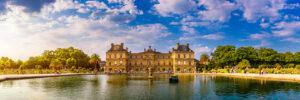
From then on, the parliamentary vocation of the Luxembourg Palace was sealed.
Cazeneuve Castle and its Queen Margot
There is no sweet prison nor foolish love.
Residence of Marguerite de Valois, first wife of Henry IV, King of France and Navarre, married to Henry when he was still King of Navarre and first pretender to the Throne of France, remaining sterile, Henry had her imprisoned at Cazeneuve.
The Palace of Versailles and the Kings of France
Castles of foreign sovereigns and kings in France
Having seen some of the castles of the kings of France, we can draw up an overview of the French residences that have hosted non-French sovereigns.
French, because they are located on the territory that is now French:
The Royal Palace of Pau
It belonged to the sovereign Kingdom of Navarre.
Henri de Bourbon, son of Antoine de Bourbon and the Queen of Navarre Jeanne d'Albret, was born there on December 13, 1553.
Henry first succeeded his mother on the throne of Navarre, and then became King of France and Navarre, by Salic devolution (in force in France, but not in Navarre).
Three centuries later, Emir Abd El Kader was held captive there with his entourage from April to November 1848.
He will then say: These green plains, these orchards, these forests, these rivers and streams; so much abundance! What need do the French have to occupy my country of sand and rocks?
The Royal Palace of Nérac
Palace of the Kings and Queens of Navarre
Nérac Castle is a Royal Palace, built in the Louis XII style: a transition between Gothic art and the Early Renaissance.
Completed during the reign of Jeanne d'Albret, who held her court and government there.
It is located directly above the Baise river.
The castle was dismantled during the French Revolution.
The north wing is the only one to have been preserved out of the four wings that defined its square courtyard.
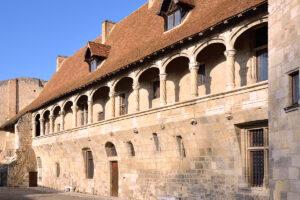
A manor house is mentioned in 1088. In the 12th century, the monks of the Abbey of Saint-Pierre de Condom were granted possession of the town and lordship of Nérac. To protect it, they chose as their advocate a defender of the abbey: Amanieu d'Albret.
The castle was subsequently occupied by Amanieu VI d'Albret in 1259, who was its castellan.
In 1306, the Albret family finally became recognized as lords of Nérac, to the detriment of the monks.
Initially linked to the House of Armagnac, the House of Albret joined the Kings of France following the defeat at the Battle of Launac in 1362.
Charles I was killed at the Battle of Agincourt. His son, Charles II, fought in Guyenne alongside Xaintrailles and Lahire against the English.
Jean d'Albret, through his marriage in 1484 with Catherine de Foix, Queen of Navarre, became king of Navarre de jure uxoris (by right of his wife).
The devolution of the Kingdom of Navarre:
Upon the death of Sancho the Strong, the Navarrese lords, refusing to see the kingdom of Navarre united with the powerful Aragonese neighbor, appealed to Count Thibaut IV of Champagne, grandson through his mother Blanche of Navarre of King Sancho the Wise.
The kingdom of Navarre then passed to the house of Blois-Champagne, then, in 1305, with the accession of Philip IV, King of Navarre de jure uxoris under the name of Philip I, it passed to the Capetians.
The throne of Navarre was then passed on to the Capetians of Evreux-Navarre from 1349, then to the Trastamara in 1441, then to the house of Foix in 1479, then to the house of Albret in 1484, and finally to the house of Bourbon in 1555.
The Palace of the Kings of Majorca in Perpignan
Attached to the Kingdom of Catalonia, former March of the Carolingian Empire, not subservient to Frankish territory or to the kings of the Franks.
The Palaces of the Dukes of Savoy in Chambéry and Nice
Originally, Savoy was a Carolingian county attached to Charlemagne's Empire, but not subservient to Frankish territory or to the kings of the Franks.
The County of Savoy was then granted the title of Duchy by Emperor Sigismund in 1416. The Counts, then Dukes of Savoy, established their administration, Chamber of Accounts, apartments, and had the Chapel of the Holy Shroud built at the Château de Chambéry.
They also established a palatial residence in Nice.
The Dukes of Savoy will become sovereigns of Piedmont-Sardinia and establish their capital in Turin.
It was only with the annexation of the territories of Savoy and Nice to France in 1860 (agreement negotiated between Napoleon III and Camillo Cavour then ratified by the Turin chamber and approved by popular referendum) that the castles of Nice and Chambéry became French.
The kings of Morocco, Hassan II and then Mohammed VI, at the castles of Betz and Armainvilliers
The Castles of Pau and Amboise, and Emir Abd El Kader
After the failure of his political project in Oran and his defeat against the French army, the emir left North Africa with his entourage, his smala, of 87 people, including his mother Zhora, his wife Khiva, his five concubines, his three legitimate children and four natural ones, an uncle, three brothers.
They were initially interned for five years at Fort Royal on Île Sainte-Marguerite under very harsh conditions. Several children from the Smala died on Sainte-Marguerite between 1843 and 1848.
The French government then transferred the Emir and his entourage to the Royal Castle of Pau on April 29, 1848. They stayed there, under the guard of 20 soldiers, until…
In Pau, the former royal castle was emptied of its furnishings for the occasion.
He will say:
An Arab in mourning does not leave his tent, and I am in the greatest mourning of my life, the mourning of my freedom!
The monotony of captivity is broken by visits from the town's notables and ladies.
Everyone shows him great sympathy, and he, in replying to a letter, reveals the pain of his exile:
Ah! Madam! I am a prisoner. You could overwhelm me with flowers, but their fragrance would not reach me!
The emir readily discusses philosophy, science, and religion, particularly with the Bishop of Algiers, Mgr Dupuch.
Emir Abd El-Kader and his entourage left Pau for the Château d'Amboise on November 2, 1848.
“When I leave Pau, I leave a piece of my heart ,” he said.
As he left, he entrusted the little money he had:
I am poor, but there are people in your town poorer than I. Please ask the venerable priest of Saint-Martin to distribute this offering to them in my name!
His jailers in Amboise, familiar with Arab customs, finally allowed the installation of mats, carpets and stoves in the castle, as well as the introduction of food based on spices and fruits.
In December 1852, Emperor Napoleon III released Emir Abd El-Kader and received him in Paris before he left for Damascus.
Very popular in France, Emir Abd El-Kader returned there in 1865 and 1867 for the Universal Exhibition.
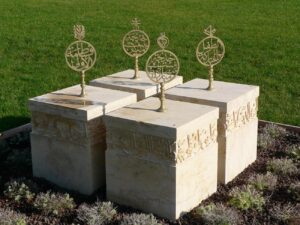
25 members of the Emir's entourage died at the Royal Château of Amboise.
A garden-cemetery was created there in 2005 by the Algerian artist Rachi Koraïchi: a place for meditation, which includes 25 stelae made of Aleppo stone, marked with surahs from the Quran and surmounted by a bronze sign, each bearing the name of a deceased person. Seven cypress trees, guardians of the link between earth and sky, and a large diagonal of rosemary, oriented southeast, indicate the direction of Mecca.
What is the name of the part of the castle where the King had his apartments?
The King's Lodgings.
The current Conciergerie of Paris corresponds to the part inhabited by the Capetian kings: the King's Lodgings.
Later, it became customary to speak of the King's Apartments: the Grand Apartment where he appeared in public, the private apartment where he was supposed to live away from view.
One might then think that the King does not govern from his private apartments…
While Louis XVI seems to have enjoyed a few moments of tranquility there, his grandfather, Louis XV, kept his secret office there: from where he governed the diplomatic and secret actions of France. Louis XV received the Count of Broglie in his private apartments, who carried out and advised the King's secret .
Etiquette dictates that certain common words lose their everyday meaning when referring to kings.
Thus, the King's Chamber, Bed and Cabinet are not what one thinks they are.
What is the King's Cabinet?
The King's Cabinet has little to do with the latrines.
They meet there to assist the King's government, to arbitrate and decide.
What is the King's Chamber?
A chamber for projects and advice, the King's Chamber is not a place for dreams.
What is the King's bed?
The King's Bed is the Bed of Justice.
We could, therefore, attempt to draw a parallel between the King's Bed and the divans* of the Sublime Porte and the Persian Empire.
*The words divan (Turkish), diwan (Persian) refer to the entire administration of the Empire.
What do you call the circular architecture of a fortified castle?
It is called a shell keep: it consists of an ovoid or circular enclosure surrounding a small mound forming the inner courtyard, and buildings containing living quarters, kitchens, stables, and outbuildings that surround this inner courtyard and are built against the ramparts. The enclosure has virtually no flanking towers, but at least one fortified gate defended by a drawbridge or a removable one spanning a ditch.
Between 1071 and 1099, shell-keeps, or shell dungeons, were built in Normandy and England from the existing castle mounds.
A few examples of this still exist in France today:
– In Normandy: Courcy (Calvados), Vatteville-la-Rue (Seine-Maritime), Avrilly (Eure), Argentan (Orne) or La Haye-du-Puits (Manche).
– On Plantagenet lands.
– In Côte-d'Or (Antigny-le-Château), in Vendée (La Roche-sur-Yon), in Charente-Maritime (Pisany and Saint-Jean-d'Angle ), in Loire-Atlantique (Clisson).
These keeps are very different from tall, narrow towers, without an inner courtyard, arranged on several levels and covered with a roof.
Which castle should you visit in France?
All castles in France, worthy of bearing this title, should obviously be open to the public in one way or another.
Which celebrity owns a castle?
Pierre Richard has owned Château Bel Évêque since 1986.
Michel Legrand and his wife Macha Meril have owned Domaine de la Motte, a small late 18th-century castle located near Montargis, in the Loiret region, since 2006.
Gérard Vives has owned the Château de la Vernée in Burgundy since 2013.
François Fillon and his wife Penelope have owned the Manoir de Beaucé since 1984.
Catherine Deneuve owns the Primard castle
Josephine Baker owned the Château des Milandes from 1947.
Mohammed VI owns the Château de Betz, in the Oise region, which his father, King Hassan II, had acquired in 1972.
Which films have been shot in castles?
Since 1896, several thousand films have used castles as locations for actors, sets, and filming locations. Chateaux-France offers a collaborative approach to filming in castles , presented by location and by film.
What is the history of the castle?
The story of a castle revisits the history of the country by offering a perspective that is often on a human scale.
A story that can be touched and felt.
A story whispered by the stones, which becomes more audible to us.
A clearer story, because, finally, we see it up close.
Who lives in the castle's main house?
The lord of the manor is not one of them. Not by a long shot!
This may seem strange: in the language spoken in the Middle Ages, the castellan was a secondary figure in the castle, responsible for managing the castle and the surrounding territory. A loyal servant attached to the castle and its domain, he collected its tax revenues and oversaw its upkeep. He remained, however, the most regular inhabitant of the castle, but was not the resident of the main house.
The main actors in the castle undoubtedly remain its "lords*" or its "ladies", to whom the royal power has entrusted the task of preserving and defending common goods.
When you take on such a responsibility, you are often away from home…
* The word monsieur derives directly from the word seigneur.
It is used in the French language for the first time in a 9th century document by the use of the two distorted Latin words: meos and sendra ( Oaths of Strasbourg, 842 ).
This new word , from the language of feudalism, allows to mark an attachment, a possession in the feudal sense: sendra or senior designates the one who depends** on the lands or people and meos or meus designates the possessive.
At that time, when one said "sir ," one meant to make a declaration which then had serious consequences: I am attached to you and I depend on you; You are the one on whom I depend.
** This dependence is not understood as belonging but as control over a thing or a person.
What is the tallest dungeon in the world?
The Crest Tower rises to a height of 52 meters.
Along with the Vincennes keep, which rises to 50 meters, it is one of the tallest in Europe and the world.
Who lives in the castle dungeon?
It is common for the castle keep to be inhabited, but this is not an absolute rule: as the main tower of the fortified castle, it is the last line of defense.
It is not uncommon to see castles with living quarters, whose keeps serve for the preservation of property and the defense of the place.
When it is inhabited, the keep is inhabited by the lord.
What is the tallest castle in the world?
The Crest Tower rises to a height of 52 meters.
Along with the keep of Vincennes, which rises to 50 meters, it is one of the tallest castles in Europe and the world.
Rocca Calascio Castle , in Abruzzo, Italy, at an altitude of 1,460 meters, is the highest castle built in the world. Its construction began in the 10th century with an initial watchtower. The surrounding wall, with four cylindrical towers, was added in the 13th century around this first tower.
It served as the setting for the filming of the film The Name of the Rose, by Jean-Jacques Annaud, with Sean Connery, Christian Slater, Helmut Qualtinger, Elya Baskin, Michael Lonsdale, Volker Prechtel, Feodor Chaliapin Jr.
What is the smallest castle in the world?
One of the smallest castles in France is located in Marnes, it is the Château de Retournay, with a ground area of 11 m by 8.5 m (i.e. less than 100 m²), 15 meters high, it is the smallest castle in France.
With a frontage of 40 meters and a width of 14 meters, the Château de Troussay is, for its part, among the smallest castles of the Loire.
What is the oldest castle in the world?
Castel Merlet was a castle located above the village of La Malène, in the Tarn gorges, in Lozère. This castle, now completely ruined, whose foundations have been discovered, is believed to be the oldest castle in France and dates back to the 6th century.
What is the largest fortress in the world?
The Teutonic Fortress of Marienburg, in Polish: Zamek w Malborku,
Located in Poland, with an area of 143,591 m², Malbork Castle is the largest castle in the world. Founded in 1274 by the Teutonic Knights who used it as their headquarters to defeat and convert the Poles and Balts, and then rule over their northern Baltic territories.
In France, the Château de Fougères is considered the largest fortress in a state of preservation.
What is the largest palace in the world?
The largest palace in the world by area enclosed within its walls is the Forbidden City in Beijing, China, which covers an area of 728,000 m². The 980 buildings of the Forbidden City have a total area of 150,001 m² and contain 9,999 rooms (an ancient Chinese belief held that the god Yu Huang lived in a palace of 10,000 rooms; out of respect, they limited themselves to a palace with 9,999 and a half rooms).
The largest residential palace still in operation in the world is the Istana Nurul Iman in Brunei. Spanning 200,000 square meters, it boasts 1,788 bedrooms. The building also features 257 bathrooms, a banquet hall seating 5,000 people, a garage for 110 cars, five swimming pools, and an air-conditioned stable for up to 200 polo ponies.
In comparison, the Palace of Versailles has 2,300 rooms, spread over 63,154 m².
Which is the most visited castle in the world?
With 8,100,000 visitors per year, the Palace of Versailles is undoubtedly the most visited castle in the world.
Which castle is surrounded by water?
As a natural element, water erodes, wears away and shapes.
An insatiable architect of impossible designs, water cannot be tamed. And cities, urban planning, concrete encasements, dikes, breakwaters, blocks, and other structures are powerless against the force of water.
So how could we have conceived of permanent structures such as thousand-year-old castles built on water?
Boasting exceptional views of the Loire, surrounded by moats or bodies of water, some castles literally have their feet in the water!
Moat at the Château du Plessis-Bourré
The Château du Plessis-Bourré, in Écuillé, appears to float on the water.
It was in fact built on a platform surrounded by moats, themselves supplied with water by diverted underground springs.
Built in just five years in the 15th century by its patron, Jean Bourré, treasurer to Louis XI, it combines the characteristics of a fortress with the elegance of the Renaissance.
A river at the Château de Montsoreau
Montsoreau is the only Loire castle built in the riverbed: A first fort had already been erected there more than a thousand years ago.
Built in the 15th century on the model of Italian palaces.
A series of ponds and moats at Serrant Castle
The castle of Serrant ,
Saint-Georges-sur-Loire has its feet in the moat. Its English-style park has three successive ponds.
Chambord Castle
It is built on stilts, in the middle of the marshes. A canal is dug, the marshes are drained, and ditches with full moats are dug around a platform on which the Château de Chambord is placed.
The water, so present on the original site ("chambord", in Gaulish, refers to the ford across a meander) is tamed.
Chambord is the water palace, a symbol, desired by Francis I and idealized by Leonardo da Vinci, of royal power over this natural element.
Onzain Castle ,
Built at the end of the 14th century by the lords of Neillac, it was completely redesigned by the Duke of La Rochefoucauld in the 16th century before being completely destroyed by the Black Band between 1823 and 1826.
In its heyday, Onzain was a large, tall, L-shaped castle where Francis I stayed several times. Only a small pavilion remains.
The castle of Azay-le-Rideau
Built on a small island in the Indre River during the reign of Francis I by Gilles Berthelot, the king's financier, the Château d'Azay-le-Rideau combines French traditions with Italian decor.
Today it is considered one of the jewels of early French Renaissance architecture.
the castle of Villegongis
Rising above a moated platform, Villegongis is flanked by two large round towers. The façades are built in an Italian Renaissance style, with highly elegant decorations. Completed around 1570, it was commissioned by Jacques de Brizay, a companion of Francis I.
Chenonceau can be considered a bridge-castle, built over the Cher.
Bourron Castle
The Bourron site has been continuously occupied since the Neolithic period.
It was the Celts who gave the village its name, "Bourron" or, according to older spellings, Bouvron or Borro, which comes from Bovron, the Gaulish god of water. This shows the vital role water plays within the estate and around Bourron Castle: one can still see today the Saint Sévère spring which gives rise to the canal that feeds the moat with fresh water surrounding the castle.
The Château de la Roche-Saint-Priest is situated on the Loire River.
Built on the rocky outcrop of an islet, the Château de la Roche becomes, depending on the mood of the river, sometimes a defensive rock, sometimes a romantic islet.
Which is the most expensive castle in France?
The Château d'Armainvilliers, located in Gretz-Armainvilliers in Seine-et-Marne, is for sale for 425 million euros.
Which country has the most castles in the world?
France is the country with the most castles in the world: there are more than 45,000 castles across the entire territory.
If we add the manors, lordly residences, bastides, fortified farms and mills, stud farms, country houses, private mansions, we then count 47,000 castles in France.
What is the most luxurious castle in the world?
The Château d'Armainvilliers, in Gretz-Armainvilliers in Seine-et-Marne. Located in an estate of 1100 ha, the château has an area of 9000m2, a hundred rooms including 40 bedrooms, a hair salon, three elevators, five lounges, a hammam.
The estate includes a hunting ground, two ponds, a forest, an organic farm, 36 outbuildings, a stud farm, and numerous other buildings.
What is the oldest dungeon in France?
The controversy is open between two keeps in the County of Anjou, still visible today, which vie for the glory: the keep of Montbazon built between 996 and 1006 and that of Doué-la-Fontaine built from 930.
Is this the Montbazon dungeon?
According to a charter of Robert II the Pious, written between 996 and 1006, the first construction was ordered by Fulk Nerra, the Black Falcon (Count of Anjou from 987 to 1040), who built a castellum on land belonging to the Abbey of Saint-Paul de Cormery, without prior authorization. A stone keep measuring 20 meters by 15 meters was reportedly erected at that time.
This first tower originally had two levels. Attributed to Fulk Nerra, before the stronghold was conquered by the House of Blois, opposed to that of Anjou.
It was quickly countered, on the south side, by a significant influx of earth which protected the base of the tower. Geoffroy Martel, son of Foulques Nerra, having taken back the fortress from the counts of Blois, partially destroyed the keep, raised it by two stories, repaired its base and had a forebuilding constructed to the East.
Is this the keep of Doué, at the castle of Doué-la-Fontaine?
Originally called the motte of the Chapel, the site seems to have developed during the Merovingian period, as evidenced by the presence of sarcophagi.
During the 8th and 9th centuries, the Carolingian kings, and later the kings of Aquitaine, had a residence in Doué, referred to as a villa or palatium . Prince Louis, King of Aquitaine, made it one of his favorite residences.
Around 900, a Carolingian aula (a large, single-story hall) measuring 23 x 17 meters with thick walls (1.7 to 1.8 meters) was built. Thirty to fifty years later, a fire destroyed the roof structure. Its openings were then bricked up and the walls covered with whitewash. It was subsequently raised by one story, and the ground floor became a large, windowless cellar.
Access is via the upper floor, 5 meters above the ground, via a timber-framed staircase; the hall is thus transformed into a fortified keep (tower-donjon), making Doué-la-Fontaine the oldest known stone castle and keep.
At the beginning of the 11th century, the lower part of the building was covered with mounds of imported earth to prevent undermining, thus concealing the exterior walls of its ground floor, which was transformed into a cellar. The aula, itself converted into a castle mound, was buried to a depth of 5 meters, reinforcing the mound upon which a wooden fortification was erected. The defensive system was completed by a ditch around the mound, 5 meters deep and approximately 15 meters wide.
Today, of the tower that was destroyed in the 11th century, only the earthen mound remains: the original Carolingian aula. Only the first courses of the 950s addition remain on the top of its walls.
Its rectangular keep is the oldest known still standing in Europe, erected during the reign of Charles the Bald, grandson of Charlemagne.
The building marks a major historical transition: that of the passage from wooden fortifications, common in the Merovingian and Carolingian eras, to the first structures in hewn stone, capable of withstanding more powerful assaults and lasting over time.
Here, the keep is rectangular in structure, made of tufa stone. The walls are about 1.60 meters thick, and the narrow openings testify to a defensive purpose.
Unlike later castles, which featured circular towers, machicolations, or parapet walks, Doué-la-Fontaine predates the golden age of medieval military architecture. It is considered a prototype, an architectural milestone between the Carolingian palace and the feudal fortress.
Traces of an annex palatial building and an inner courtyard have been identified, giving the castle its administrative and residential character.
What is the tallest tower in a castle?
The keep, the castle's main tower, is its last defensive structure. It dominates the entire castle complex .
What is the largest dungeon in the world?
The Crest Tower is the former keep of the medieval castle of Crest in the Drôme region. Standing 52 meters tall, it makes the Crest Keep the largest in the world.
The base of the tower is Roman and dates from the 4th century. The rest dates from the 11th to the 15th centuries.
In 1632 Cardinal Richelieu had the castle of Crest destroyed. Only the massive tower overlooking the town remained.
Which European country has the most castles?
With more than 47,000 castles, manors, palaces, stately homes, fortified farms and mills, stud farms, country houses, private mansions, France is the country with the most castles in the world.
Which department has the most castles?
In France, the Dordogne, known as the "land of a thousand castles , " is the department with the most castles. With nearly 620 castles and 380 characterful residences, the Périgord region is nicknamed the " land of 1001 castles ."
Which region of France has the most castles?
New Aquitaine is the region of France with the most castles in France.
Are castles only found in France?
No, castles are not only found in France; they exist all over the world, particularly in Europe.
The presence of castles around the world
In Europe: Many countries possess an immense fortified or residential heritage. For example, Germany, the United Kingdom (with Windsor Castle), the Czech Republic (with Prague Castle) and Wales have exceptional concentrations of castles.
In Asia: Countries like Japan have their own architectural traditions of fortresses, exemplified by the famous Himeji Castle.
In the Middle East: Major medieval monuments are located there, such as Krak des Chevaliers.
The situation in France
France is very famous for its "French castles", but also for its fortresses and palaces.
The territory has as many castles in France as there are approximately 30,000 to 45,000 buildings, from medieval remains to Renaissance residences.
But the meaning of the word castle varies depending on the linguistic culture.
When an English speaker asks this question, they don't use the word "château" in the same way as a French speaker. For them, "château" specifically refers to a large bourgeois residence, a palace, or a large wine estate in a typically French style, located in the countryside.
In English, the distinction between types of castles is very marked, whereas French uses the same word for everything: A medieval castle (fortified, with towers and a moat) is called a castle. If an English person were thinking about military fortresses, they would ask "Are castles only in France?" (to which they already know the answer is no, since there are castles in England and Scotland).
An urban royal or princely palace (like the Louvre) is called a palace. In fact, English speakers translate the Château de Versailles as The Palace of Versailles.
A Renaissance or 18th-century style castle, unfortified and elegant, is what they call a castle.
What he imagines by "castle"
– A precise architectural aesthetic: White stone facades, large windows, very high and pointed slate roofs, or, conversely, "Mansart-style" roofs, and sometimes decorative turrets.
– Bordeaux wine: In the English-speaking world, "château" is closely linked to large wine estates (Château Margaux, Château Lafite, etc.).
– A pleasure residence: A very luxurious manor house or country house.
In summary, when he asks if "castles" only exist in France, he is really asking: "Does this particular style of residential palace and large elegant French estates exist outside the borders of France?"
Indeed, this architectural style (the French Chateau Style) was copied abroad, notably in the immense properties of American billionaires in the 19th century.
The architectural style inspired by French châteaux (known as Châteauesque or French Renaissance Revival) enjoyed immense success abroad, particularly in North America during the late 19th century (the Gilded Age). The wealthy of the time wanted to display their immense riches by copying the châteaux of the Loire Valley.
Characteristics of the "Châteauesque" style
This architectural style is easily recognizable abroad thanks to systematic visual elements borrowed from French heritage: extremely steep and elevated slate roofs, decorative turrets and pepperpot roofs (conical roofs) reminiscent of old fortified castles.
Highly ornate Gothic or Renaissance decoration around the windows and along the cornices.
Here are the most spectacular examples of "French Chateaus" built outside of France:
– In the United States, the Biltmore Estate, located in North Carolina, is the largest private residence in the United States. Built by George Washington Vanderbilt in 1895, this 250-room castle was directly inspired by the Château de Blois and the Château de Chambord. It features sculpted dormer windows, tall chimneys, and pointed roofs typical of the French Renaissance.
– Oheka Castle (Long Island, New York). Located on Long Island's prestigious Gold Coast, Oheka Castle is the second largest private residence ever built in the United States. Designed in 1919 for financier Otto Hermann Kahn, this 127-room castle draws direct inspiration from classical French architecture and is surrounded by sumptuous formal gardens. It notably served as inspiration for Jay Gatsby's estate in the novel The Great Gatsby.
– The Elms (Newport, Rhode Island). The coastal city of Newport is full of extravagant mansions built by New York high society as "summer homes." The Elms, completed in 1901 for coal magnate Julius Berwind, is a near-perfect replica of the Château d'Asnières near Paris. Its symmetrical limestone facade, stately terraces, and extravagant interiors make it an absolute model of French classicism in the heart of America.
– Ochre Court (Newport, Rhode Island). Built in 1892 by architect Richard Morris Hunt (the same architect who designed Biltmore Estate), Ochre Court is an incredible late Châteauesque mansion. Located on the oceanfront, its exterior draws inspiration from French Flamboyant Gothic and the Loire Valley châteaux, with exquisitely carved dormer windows, turrets, and soaring slate roofs.
In Canada, many grand private mansions are inspired by this aesthetic, particularly in ultra-luxurious neighborhoods like Bridle Path in Toronto or in the province of Quebec. Canadian architects have widely adopted symmetrical stone facades, monumental columned entrances, and Mansard roofs to design these exceptional properties.
What can you see and do around the Castle?
A castle is most often surrounded by its park and showcased by gardens.
Outbuildings, service buildings, commons, stables, farms, barns, mills, chapels, abbeys, churches, temples, dovecotes, icehouses… may also accompany it and still be visible.
Is it possible to have a candlelit dinner at the castle?
Candlelit dinners are possible in many castles: these are mostly fleeting and seasonal moments.
The best known are the candlelit dinners at the Château de Valençay in the Loire Valley, the Château de Quintin in Brittany, the Château de l'Augère in Bourbonnais, and the Château de Losse in Périgord.
You can also have a candlelit dinner as part of a stay at the castle.
How much does a wedding at the Château cost?
For renting rooms at the castle, the average budget varies from €1,500 to €3,500.
The average cost for the complete privatization of a castle for a wedding can start at around €6,000 up to €30,000 and more, depending on the level of luxury, the number of accommodations and the duration of the rental.
In addition to this, there are the traditional services of a wedding celebration, namely: the rental of tables, chairs, cutlery, decorations, flowers, catering services, sound system, photographer, accommodation, printer…
And don't forget the cost of extra services (babysitting, car rentals, arrival by parachute, hot air balloon, horse-drawn carriage, sedan chair, oxcart, giant pumpkin… Only your imagination will guide your choices).
What should I wear to go to an escape game in a castle?
Dress however you like, but choose light, stretchy, and breathable clothing. Cotton joggers, leggings, or stretch pants are perfect, paired with a flowy t-shirt or a light sweatshirt. If you're comfortable, you can focus on the puzzles.
This time, there will be no ball at the castle!
How long does it take to visit the castle?
We recommend allowing 1 to 2 hours for your visit to discover the tour route of a castle.
Some, like the grand royal and princely palaces, will require more time.
You can easily spend the day in castles, palaces, parks or places, which are organized into circuits and fun, sporting, themed activities, workshops, costumes, restaurants, zoos, parks and gardens.
Some places also offer stays in the castle and wellness, sports, and local discovery services.
Whether for a few moments or for entire days, an experience at the castle is a change of scenery, a breath of fresh air, culture and laughter that enriches and awakens visitors: Open your eyes!

How to book a night or a weekend at the castle on Châteaux France?
To plan your weekend getaway at a castle or an unusual overnight stay , simply use our search engine by theme or region. You'll find a carefully curated selection of exceptional accommodations: castle bed and breakfasts , luxury hotels , guesthouses and vacation rentals, or even castles available for exclusive rental . Click on your chosen property to check availability and submit your booking request directly online.
What are the conditions for renting a castle for a wedding or seminar?
Renting a castle for an event (wedding, private reception, family celebration) or for a corporate seminar is a bespoke service. Each castle rental listing for weddings includes a direct contact form to request a free quote, check the capacity of the reception rooms, and confirm accommodation options for your guests.
Do you offer unusual activities such as escape games at the castle?
Yes, the platform lists many immersive experiences. You can book an escape game at a castle for a historical adventure with family or friends. We also list other cultural and leisure activities: castle visits in France , exploring listed parks and gardens, dining at castle restaurants , and even wellness and spa breaks in period settings.
How to rent a castle for a film shoot or photo shoot?
Châteaux France connects film and television professionals (cinema, television series, advertising, photo shoots) with owners of historic monuments. Thanks to our dedicated filter for castle rentals for filming , you can access unique period settings and contact estate managers directly to plan your location scouting and filming.
I am the owner: how do I register and list my castle on the site?
If you own a historic monument, castle, or exceptional estate, you can register your property by clicking on the dedicated tab at the top of the page. Complete the partnership form to list your property and start receiving qualified inquiries for your rooms, event space, tours, or filming locations. Our team will validate your registration within 48 hours.
What are the advantages of using Châteaux France rather than a traditional directory?
More than just a traditional castle directory that simply lists addresses, Châteaux France is a dynamic platform focused on experience and booking. Whether you're looking to stay in a castle , rent a historic filming location , or participate in an activity, we vet each property to guarantee you direct, transparent, and intermediary-free contact with the owners of France's heritage sites .
And what about the history of Chateaux-France?
A pioneer on the Internet, the first website was launched in October 1995: Chateaux-France.com
Next comes:
Chateaux-France.fr, Frankrijk-Kastelen.com , Schlosser-Frankreich.com , Castelli-Francia.com
Since that date, millions of visitors have discovered the historically rich sites presented by Chateaux-France.
Now your story begins…